Bare Concrete Ready for Long-Term Performance
Floor Demo & Grinding in Bridgeton for slabs buried under old adhesive, failed coatings, or layers of worn flooring material
Older commercial buildings and industrial spaces across South Jersey were often floored with vinyl composition tile, carpet squares, or painted coatings that were applied directly to the slab, and when those materials fail or the building changes use, what remains is a surface covered in mastic, adhesive residue, or brittle epoxy that blocks any new floor system from bonding. Durashield LLC removes old flooring and grinds concrete slabs in Bridgeton and throughout the region, clearing the surface down to bare concrete and profiling it so the next coating system has clean, open pores to bond into. The same crew that demolishes the old floor handles the grinding and prep, so there is no handoff between trades and no delay waiting for the slab to be ready.
Demo starts by pulling up the existing floor covering—tile, carpet, rubber, or sheet goods—then moves to the adhesive layer underneath, which in many cases is a black cutback mastic or a pressure-sensitive glue that has hardened into the concrete over decades. Scrapers and ride-on grinders remove the bulk of the material, and diamond tooling opens the concrete surface to an even profile that new coatings can grip. Dust is controlled with vacuum-attached equipment, and all debris is hauled off site once the slab is bare. Before any new floor is specified, the slab is inspected for cracks, spalling, and moisture intrusion, so the coating system is matched to the actual condition rather than what was assumed.
Schedule a slab evaluation to identify adhesive layers and surface conditions before the new floor is planned.
What Proper Grinding Accomplishes Beyond Surface Removal
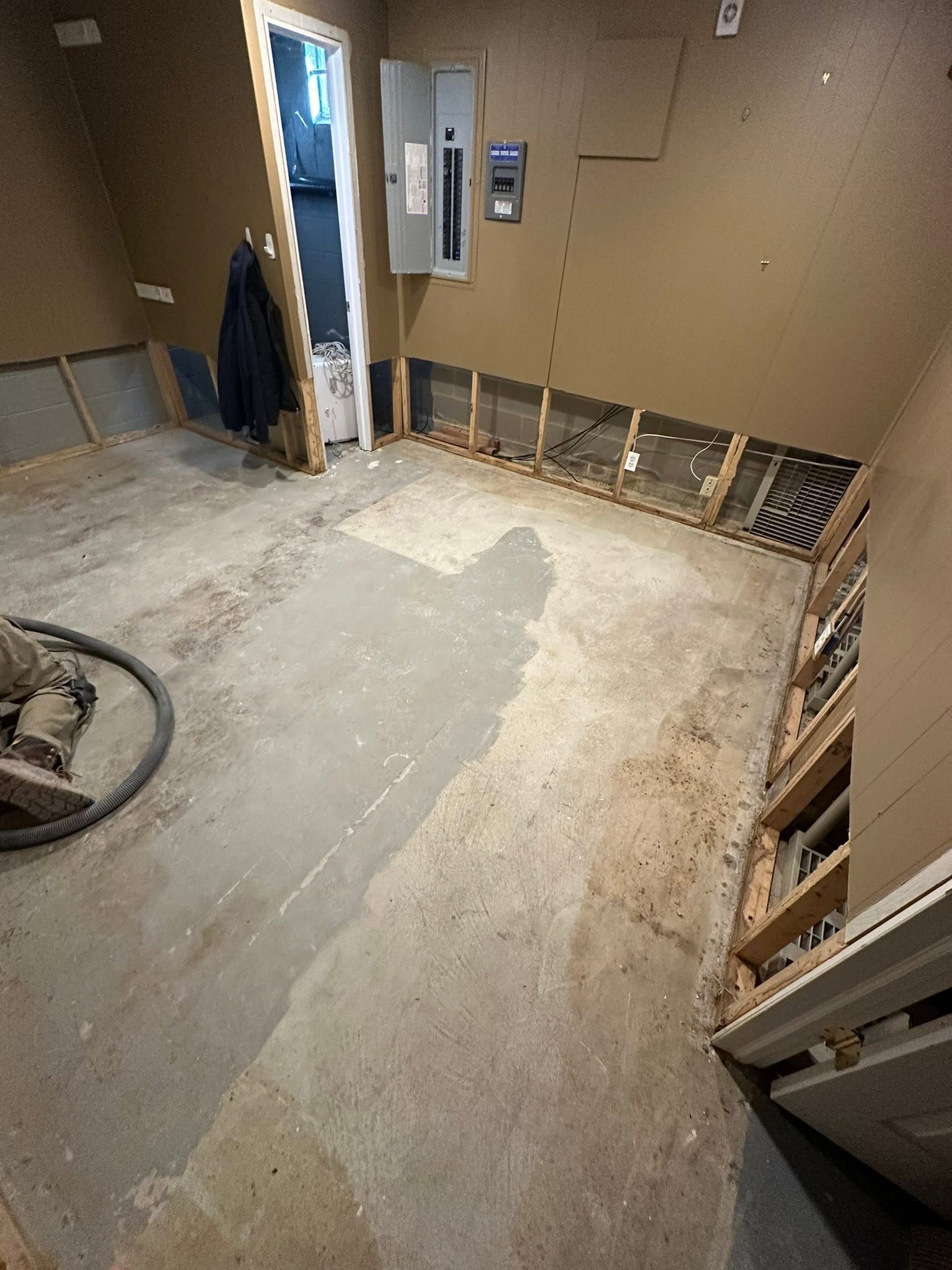
Grinding does more than remove old material—it opens the concrete's surface pores, creating a texture that mechanical coatings depend on for adhesion, and it levels high spots and removes surface laitance, the weak cement layer that forms during the original pour and cure. Owner-operators with about 37 years of combined experience bring the grinders and equipment to finish prep on the same visit, so the slab does not sit exposed between crews.
Once grinding is complete, you are left with a uniform, abraded surface that feels rough to the touch and shows no gloss or smooth patches. The concrete is now mechanically profiled, meaning the new coating will lock into the opened surface rather than sitting on top of a sealed or contaminated layer. Adhesive ghosts, stains, and old coatings are gone, and the slab's true condition—including cracks, joints, and any areas that need patching—is fully visible.
The work includes haul-away of all demolition debris and final cleaning of the slab, but it does not include crack repair, joint filling, or moisture mitigation, which are quoted separately based on what the inspection reveals. If the building has below-grade slabs or a history of water intrusion, moisture testing is performed before any coating system is recommended.
Answers About How the Work Is Done
Floor demolition and grinding work is straightforward in concept but varies widely depending on what is covering the slab and how long it has been there, so property owners in Bridgeton and surrounding areas often ask about the sequence, the equipment, and what to expect once the old floor is gone.
What happens to the adhesive that does not come up with the tile or carpet?
Adhesive that remains bonded to the slab is removed with ride-on scrapers or walk-behind grinders fitted with aggressive diamond segments, and the surface is ground until no adhesive film or gloss remains and the concrete shows an open, textured profile.
How is dust controlled during grinding?
Grinders are attached to industrial vacuums that capture most of the dust at the tool head, and the space is sealed where possible to prevent migration into occupied areas, though some fine dust is unavoidable in older buildings with open ductwork or poor sealing.
What does a properly prepared slab look like after grinding?
The surface appears uniformly matte with no shiny patches, feels rough to the touch, and shows the aggregate structure of the concrete, with all old coatings, adhesives, and contaminants visibly removed.
Why does the condition of the existing adhesive affect the timeline?
Black cutback mastic and older carpet glues bond more aggressively than modern adhesives and require multiple passes with diamond tooling to remove completely, so slabs with thick or aged adhesive layers take longer to grind down to a clean profile.
What should be checked before a new floor system is applied?
The slab should be inspected for cracks, spalling, moisture vapor transmission, and pH levels, because any of those conditions can cause a new coating to fail regardless of how well the surface was prepared.
Durashield LLC also performs floor demo and grinding in Atlantic City, Bensalem, Berlin, Brick, and Burlington. Both owner-operators work the job from start to finish, so the crew that quotes the demo is the same crew operating the grinders and hauling the debris, and unexpected conditions such as thicker adhesive or subsurface damage are handled on site with the equipment already on the trailer.