
Surfaces That Control Static Discharge
Anti-Static Epoxy Flooring in Bridgeton for warehouses, electronics spaces, and processing rooms where static sparks create hazards
Commercial buildings used for warehousing, electronics assembly, packaging, and food processing often need floors that dissipate static charge rather than allowing it to build up and discharge suddenly, because a single spark can damage sensitive components, ignite flammable vapors, or disrupt automated equipment. Anti-static epoxy flooring installed by Durashield LLC uses conductive systems that safely dissipate static charge in controlled spaces throughout Bridgeton and across South Jersey, with copper grounding strips or conductive tape set into the coating and tied to the building's electrical ground. Both owner-operators work the floor on every job and handle grounding and layout on site, rather than passing the work to a crew they have not supervised, so the system is installed correctly the first time and tested before handover.
Installation begins with confirmation of the substrate and moisture condition, because anti-static systems require a stable, dry slab to function reliably. The concrete is ground and profiled for adhesion, and any cracks or defects that could compromise conductivity are repaired. A conductive primer is applied, followed by a base coat into which copper grounding strips or conductive tape are set, spaced according to the system specification and tied to the building's ground via connection points typically located at the perimeter or at equipment pads. The topcoat is applied after the base has cured, and the entire system is tested for resistance before the floor is released for use. Testing and grounding details are quoted separately from the coating itself, because the number of grounding points and the layout complexity vary with the building's electrical system and the floor area.
Schedule a substrate evaluation and grounding consultation to confirm the slab condition and identify connection points before the system is specified.
Why Conductive Systems Work for Static Control
Anti-static flooring dissipates charge by providing a continuous conductive path from the floor surface to the building ground, so static electricity generated by foot traffic, wheeled carts, or equipment movement is bled off gradually rather than building to a discharge threshold. The grounding strips embedded in the epoxy are the critical component—they create a network of low-resistance paths that connect to the ground and allow charge to flow away from the surface. Owner-operators bring a fully equipped trailer so grounding and surface problems found on site are handled the same day, without waiting for specialized equipment or a return visit.
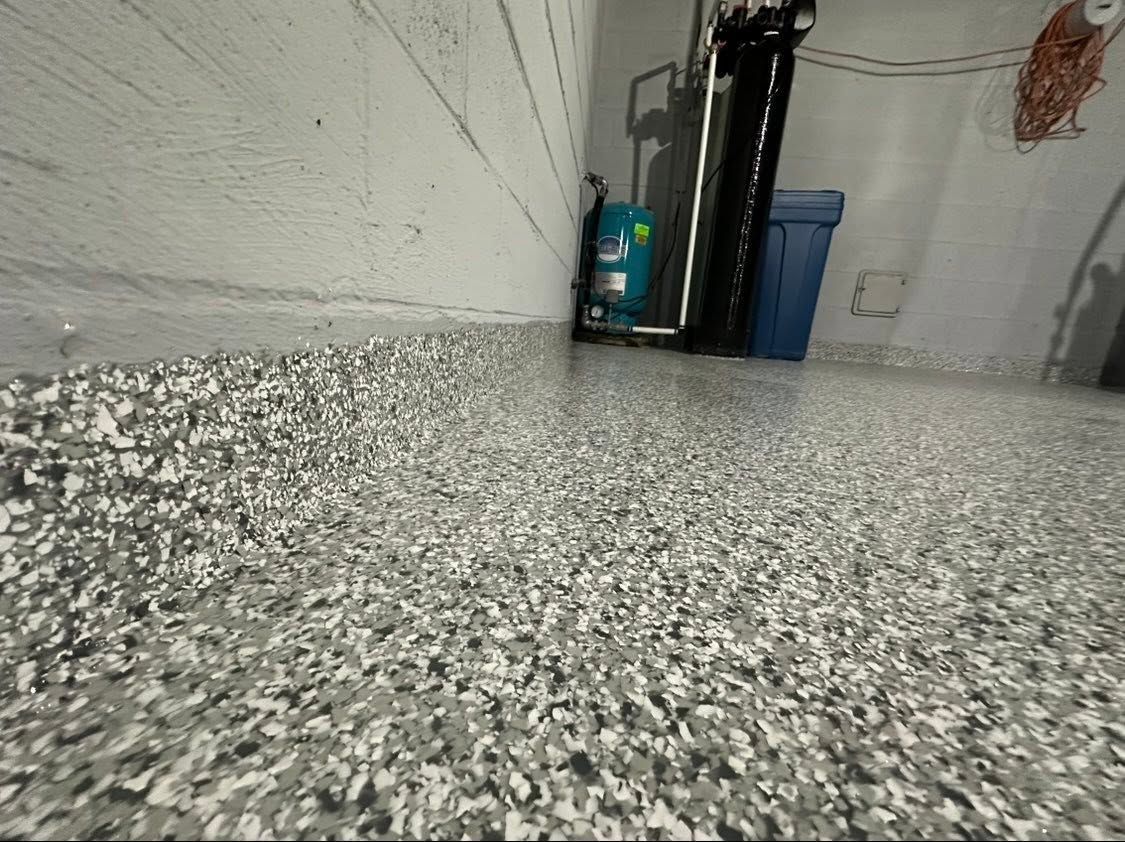
Once the system is installed and tested, you will notice that the floor looks like a standard epoxy coating but performs differently under static testing, and workers in the space no longer experience static shocks when touching grounded equipment or metal surfaces. The floor dissipates charge continuously, so sensitive electronics and flammable materials are protected from static discharge events.
The installation includes substrate preparation, conductive primer, base coat with embedded grounding, topcoat, and resistance testing, but it does not include modification of the building's electrical ground or installation of additional grounding rods, which are the responsibility of a licensed electrician. If the slab has high moisture vapor transmission or the building lacks an accessible ground, those conditions must be resolved before the anti-static system can be installed.
What Property Owners Ask About the Work
Anti-static flooring involves grounding, testing, and material specifications that differ from standard coatings, and facility managers in Vineland and Glassboro often want to understand how the system is installed and what performance standards apply.
What is the difference between anti-static and static-dissipative flooring?
Anti-static flooring typically has a surface resistance between 1 x 10^6 and 1 x 10^9 ohms and is used in spaces where static discharge must be prevented but rapid dissipation is not critical, while static-dissipative flooring has lower resistance and is specified for electronics manufacturing and explosive atmospheres.
How are the grounding strips connected to the building ground?
Grounding strips are embedded in the epoxy base coat and routed to a connection point where they are bonded to the building's electrical ground, typically at a grounding bus bar, a cold water pipe, or a grounding electrode, with the connection made by a qualified electrician.
Why does the slab need to be dry before an anti-static system is applied?
Moisture in the slab can interfere with conductivity and cause the epoxy to delaminate, so vapor emission testing is performed and any moisture issues are mitigated before the conductive system is installed.
What happens during resistance testing after the floor is finished?
A resistance meter is used to measure the electrical resistance between the floor surface and the grounding point, and multiple readings are taken across the floor area to confirm that the system meets the specified resistance range and that charge dissipates uniformly.
How is the floor maintained so it continues to dissipate static?
The floor is cleaned with neutral pH cleaners that do not leave a film or coating, because waxes, sealers, and oily residues can insulate the surface and block the conductive pathway, raising resistance above the acceptable range.
Durashield LLC also installs anti-static epoxy flooring in Atlantic City, Bensalem, Berlin, Brick, and Burlington. Both owners handle the grounding layout, coating application, and final testing on every job, so the system is installed by the people who understand how it works and who are accountable for its performance.